


Beauty and anonymity, people and spaces, closeness and distance — within his oeuvre, Robert-Sebastian Berger creates a synthesis of apparently contradictory pairs of terms. The young Cologne artist paints his often large-sized pictures in reduced colourfulness. However, this does not mean that they lack in liveliness. The motives which tend to be photo-realistic and the skillful intuitive implementation of paste-like brush strokes, bear witness to the autodidact's knowledge of his personal skills. The virtuoso style quickly wins the viewer over.
Despite the two-colour technique and the often only hinted at silhouettes of nude and portrait representations, we believe that we are capable of perceiving the main biometrical data of the models displayed.
In order to enjoy the aesthetics of the physical we are happy to take on the task of reconstructing the human appearance through our own visual experiences and with help of the key data obtained from the pictures.
Do these imaginations also correspond to reality? Are the associations created the same as those which were intended by the artist? Berger keeps us guessing as to whether we are dealing with exchangeable motives of advertising aimed at enticing the consumer or the viewer respectively, by means of their special eroticism, or rather with a sensitive individual whose unveiled physicality exposes an extracted character of the human soul arising from the spontaneous moment, not unlike snapshots.
Beauty can be seen as being relative. On the one hand, it is visibly reproducible, completely in the sense of pop art. On the other hand it can only be captured for a moment, one picture, already vanishing the moment we become aware of it.
Perhaps a visual trap or obvious inspiration from every-day life that floods us with images and forced upon ideals? In contrast to the historic development of photography, Berger's original idea of working with monochrome colours developed back to black and white, later blending in yellow and blue rendering the pictures warm and inviting by means of their effectualness.
The apparent regression at the beginning of his artistic creation is thereby remarkable: photographic painting, capturing reality as a "photograph in oil" and continuously reducing to basic allusions.
In his newer works, a picture series on September 11th, the project "People 2003", and his current exhibition "Change" located in the inner harbour of Duisburg, Robert-Sebastian Berger points us in the direction of a world in which the ability of experience would only be possible in this way by means of room installations or sculptures.
On the one hand, we are individuals in our environment, on the other hand, we are reflected viewers in the painting — the apparent anonymity of the pictures is a chance of identification, a further reason for taking another step closer to the works of Berger.
Throughout the many years of engaging himself in the various painting techniques, Berger has continuously developed the personal traits and strengths of his representations. This has meant that he has been able to give his attention to more subtle themes and ideas, which could also be increasingly recognised in his early work.
The aim is thereby not only to win over the viewer by means of a certain eroticism, an intended aesthetic, but also to enable him a latent impression of the motives of the relation between space and mankind in the physical form and the relation between time and mankind in transitoriness, beyond superficial complaisance.
To picture what cannot be pictured, meaning space, can only take place when bound by the object resp. the human body in Berger's pictures.
In this way, the young Cologner likes to take on the role of the staging creator, granting the people in his pictures a direct relationship with their environment by means of finely accented contouring as well as skillful positioning in space. An exciting task which Berger has continued in his new works which can be viewed at his current exhibition "Change" at the inner harbour of Duisburg in November / December of this year.
With the eye of a photographer, the painter focusses on people in town landscapes, shaped by industry, which he captures on the canvas with a fascinating technique. A type of painted photography that Robert-Sebastian Berger accomplishes using inverse colours, similar to that of a photo negative, has been applied in the "Change" series. An impression of estrangement is created, however the photorealistic picture illusion also develops a closeness to the viewer — an exciting experiment with variable parameters, since each visitor to the exhibition will perceive the pictures in a different way — ending unknown.
Mathias Stolz · Cologne · Translation: Andrew Payne, mgpartner.com
| 1968 | Born in Cologne, Germany — Luxembourg citizen. Paternal grandmother — Luxembourger; maternal grandmother — French; father born in Santiago; uncle born in Ascott (Great Britain). This European descent characterises the work of the artist. |
| 1985 | Residence in Ascott, England. |
| 1984–1990 | Experimental electronic music project. |
| 1985–1990 | Experimental Super 8 films. |
| 1988 | University-entrance diploma. |
| 1989 | Several educational journeys through Italy, Spain, Austria, Scandinavia, South America, France, Low Countries and England. |
| 1990–2000 | Studies at universities. |
| 1991 | Educational journeys through South America. |
| 1992 | Development of a creativity, study and visualization technique. |
| 1993 | Publication in Frankfurter Allgemeine Zeitung.  |
| 1992–1997 | Assistant professor for integrated creativity, study and visualization techniques at German colleges. |
| 1993 | Publication in the daily newspaper Die Welt.  |
| 1993 | Support by FOKUS, BDI and Daimler-Benz AG — September 1993, new concepts of development — "Haus Lämmerbuckel". |
| 1993 | Further development of painting techniques, experiments with new materials and techniques. |
| 1994 | Development of archetypes to optimize information and communication methods in cooperation with FOKUS — research group communication and social analysis. |
| 1994 | Publication in the daily newspaper Die Welt. |
| 1994 | Educational journey through South America — Chile and Argentina. |
| 1994 | Publications in specialised press. |
| 1994 | Educational journey through Africa — area around Kilimanjaro. |
| 1995 | Educational journey through Spain, France, Switzerland and Italy. |
| 1995 | Reduction on the two-colours technique and specification on photorealistic elements in the paintings. |
| 1995 | Educational journey to England — several stays in London and Bournemouth. |
| 1996 | Educational journey through France, Switzerland, Italy and Spain. |
| 1997 | Educational journey through Switzerland. |
| 1999 | Special exhibition of young artists during the ART COLOGNE.  |
| 2001 | Educational journey through Portugal. |
| 2002 | Educational journey through France — stay in Paris — own studio. |
| 2003 | Opening of a studio exhibition in Cologne. |
| 2003 | Opening of an exhibition with the topic September 11th at the ART Fabrik Wuppertal — report on ARD television. |
| 2004 | Opening of an exhibition at the gallery "Bürgmann". |
| 2004 | Negative patterns — exhibition at the Duisburger basin designed by Sir Norman Foster. |
| 2006 | Exhibition of young artists during the ART COLOGNE — Gallery Bürgmann. |
| 2007 | Saatchi Gallery — London. |
| 2007 | Exhibition / art project Montreux (Switzerland). |
| 2007 | Exhibition / art project Cannes (France). |
| 2007 | Exhibition Museum Peschkenhaus / Moers (Germany). |
| 2007–2011 | Working in the Art-Studios (Cologne, Paris). |
| 2010 | Working in London. |
| 2011–2012 | Creative projects — press reports on German television VOX and RTL. |
| 2011–2015 | Saatchi Gallery — London. |
| 2015 | ART EVENT — Cannes, France. |
| 2015 | Exhibition — Paris. |
| 2016 | ART EVENT — Montreux (Switzerland). |
| 2017 | ART EVENT — Luxembourg. |
| 2018 | ART EVENT — Cologne (Germany). |
| 2019 | ART EVENT — Cologne (Germany). |
| 2021 | Virtual Art Event — London (Great Britain). |
| 2022 | Virtual Art Event — London (Great Britain). |
| 2023 | ART EVENT — Cannes, France. |
| 2024 | ART EVENT — Cologne, Germany. |
| 2025 | ART EVENT — Paris, France. |
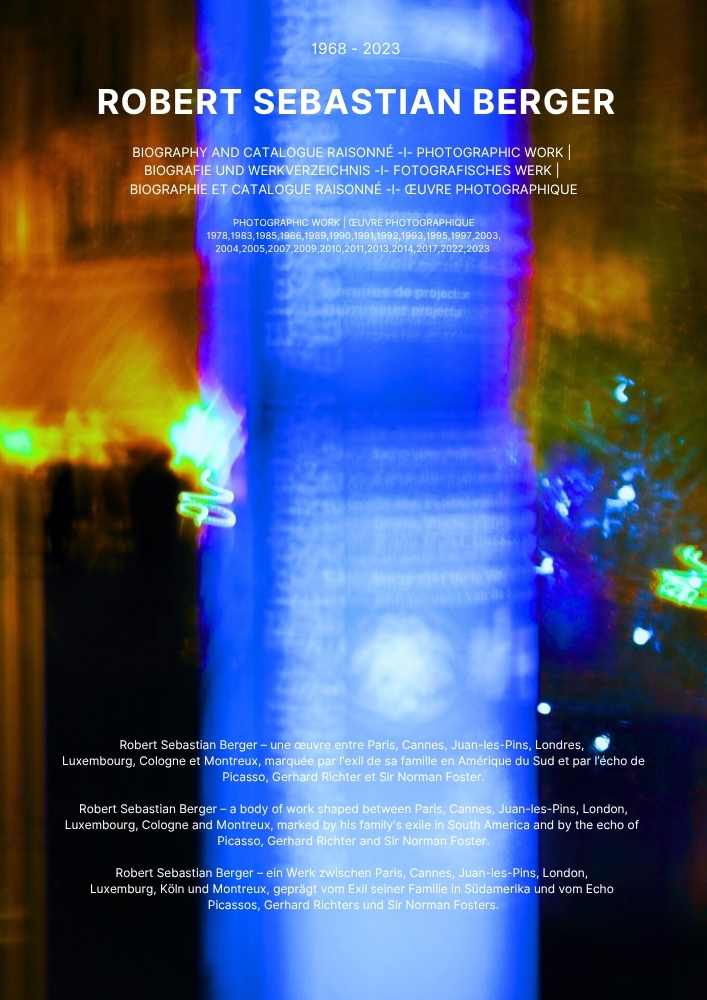
The first volume of the Catalogue Raisonné — Biographie et Catalogue Raisonné, Résumé œuvre photographique — is now available worldwide. Softcover, three languages, fully illustrated.
Order — click hereExperimental electronic music project "Smilling Rolls" (1984–1990) — inspired by the Düsseldorf group Kraftwerk.
1984 – 1990The formative decade — residence in Ascott, England (1985); first experimental works in sound and image; university-entrance diploma in 1988.
1980 – 1989Experimental Super 8 films (1985–1990) — an early visual language that would later inform the photorealistic painting practice.
1985 – 1990For inquiries regarding individual works, loans for exhibitions or acquisition, please get in touch directly with the studio. Press kits, catalogue contributions and high-resolution image material are available on request. — Contact — click here —